The fuel industry has traditionally depended on operational speed, data accuracy, and seamless coordination between participants in the supply chain. Selling fuel involves much more than simply receiving an order and issuing an invoice. The process includes checking product availability, agreeing on terms with suppliers, organizing shipments, arranging transportation, and preparing the necessary documentation.
As the number of customers and the volume of operations grow, managing these processes manually becomes increasingly difficult. Information is scattered across emails, messaging apps, phone calls, and spreadsheets. As a result, employees spend a significant portion of their working time transferring data and monitoring task completion instead of focusing on business development.
In my view, this is exactly where the digitalization of a fuel company should begin.
Automation Must Address Specific Business Needs
One common mistake in digital transformation is starting with the choice of technology rather than an analysis of business processes. Companies consider implementing artificial intelligence, sophisticated analytics systems, or new platforms without first identifying the specific operational problems they need to solve.
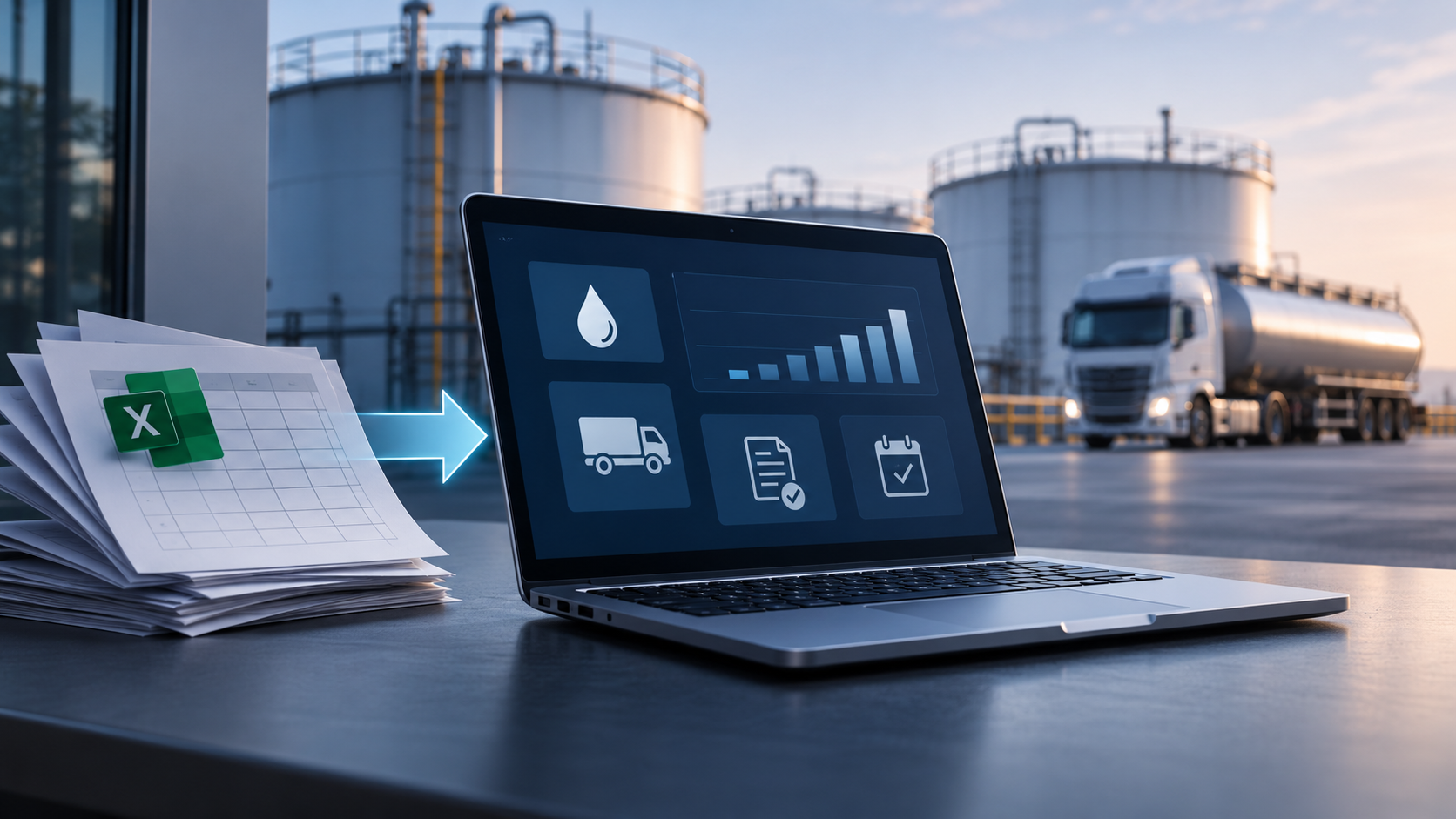
In practice, automating basic processes can deliver much greater value at the initial stage. These include receiving and processing orders, coordinating shipments, preparing documents, and exchanging information between departments.
For example, when order details are manually transferred from one document to another several times, processing takes longer and the risk of errors increases. A unified digital system makes it possible to store information in one place and transfer it between workflow stages without repeatedly entering the same data.
This is about more than saving time. It changes the entire logic of operational management.
Data as the Foundation of Management
Another important aspect of digitalization is the quality and accessibility of information.
When sales, orders, deliveries, and logistics data are stored in separate systems, it becomes difficult for management to gain a complete picture of what is happening across the business. Making decisions requires manually collecting information, comparing figures, and requesting updates from employees.
Integrating processes makes it possible to create a unified information environment. Managers gain greater visibility into ongoing operations, can identify delays more quickly, and are better equipped to assess performance.
This is particularly important in the fuel industry, where timely deliveries, accurate documentation, and coordination between supply chain participants directly affect customer service.
From Automation to Intelligent Management
The next stage in the development of digital systems involves analytics and artificial intelligence. Once core processes have been automated and data is collected in a structured format, companies can begin implementing more advanced solutions.
These include demand forecasting, consumption analysis, supply planning, and delivery route optimization. Such tools help companies not only execute day-to-day operations more efficiently but also make data-driven decisions.
However, the effectiveness of these technologies depends on the quality of the underlying digital infrastructure. Artificial intelligence cannot solve problems if information is incomplete, processes are disconnected, and employees continue to work with multiple inconsistent data sources.
Digitalization as a Long-Term Strategy
Experience in business process automation within the fuel industry shows that digital transformation should not be treated as a one-time IT project. It is an ongoing process of developing a company's management system.
This approach makes it possible to move beyond automating individual operations towards integrated management of sales, orders, documentation, and logistics.
For fuel businesses, digitalization is becoming an important factor in competitiveness. Companies that establish transparent, interconnected processes can handle more orders, use their resources more efficiently, and adapt to market changes more quickly.
The true measure of digital transformation is not the number of technologies implemented, but how much more effectively the business itself operates.
Author: Artur Slobozhaninov, Digital Transformation and Business Process Automation Specialist